
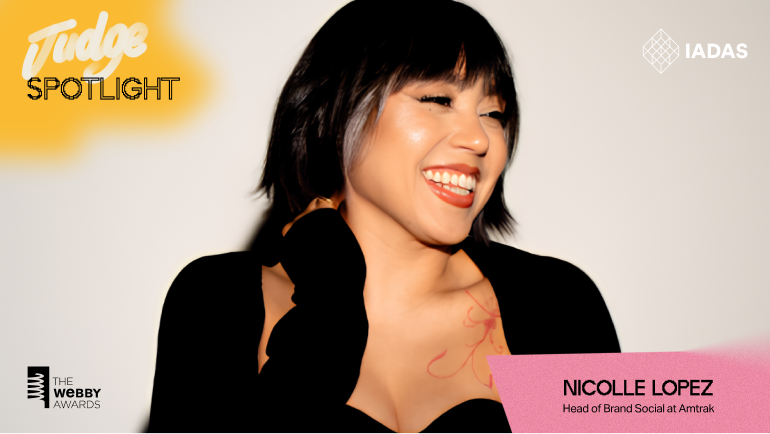


What can brands learn by looking outside their own industry? For Nicolle Lopez, Amtrak’s Head of Brand Social, an Ad Age 40 Under 40 honoree, and a Webby Awards judge, that’s where fresh ideas for how to tell stories and connect with audiences often begin.
The Webby Awards and the International Academy of Digital Arts and Sciences (IADAS) spoke with Lopez about how branching out can open up new possibilities for creatives and how staying curious about your audience can lead to stronger work.
What are you working on that’s exciting to you? Where’s your head at these days professionally?
I have two pretty big projects underway. I’ll start with brand social for Amtrak. As we all know, social media is TV now. You’re no longer switching the channel, you’re scrolling up. Everyone from creators to brands has their own episodic content, their own TV show, whether it’s a micro-drama, a reality show, or a talk show.
So my team asked: if this is the new TV, what makes people really excited to watch? The answer was crossover episodes, when two shows come together and you see two characters you love in the same world. Or even better, a beach episode. Everyone loves a beach episode. So we thought, why don’t we be the train episode? Why can’t the train be the stage for everybody else? We truly believe train travel is for everyone everywhere, so let’s prove it in the form of entertainment.
That’s been a huge initiative for my team this last year. We just worked with our partner Away on their new hit social series, Actually Away. The finale was on board one of our trains, which was really cool to work on. We’re also working with the new hit social media TV show [and Webby-winner] Roomies Roomies Roomies by BILT.
We’ll have a train episode with the Roomies going out on an adventure. It’s about finding the crossover and hosting these shows that get people on social media more, while giving the brands room to live and play. How can we be part of that?
View this post on Instagram
The other big project is that I’m creative directing the new music release for Peloton instructor and Latin music artist Camila Ramon. Music isn’t just music anymore. It’s media, it’s art, it’s fashion. So I’m approaching it as an experience: how do we bring it at scale, how do we use your platform to talk about it, and how do we go beyond what we can hear to what we can see and feel? She’s dropping new music very soon, so be on the lookout.
You cross over both creative direction and marketing strategy. Not everybody does, and sometimes those worlds don’t understand each other. How do you bring them together?
Social media is really unique. Anyone who works on a social team knows how to edit, how to film, how to write copy. It’s part of the trade. Creative direction to me is like showrunning: what is the world we’re building, and how do we apply it?
If I’m translating that into corporate speak, creative direction is taking the brand book and making it a brand family. I need to go beyond the pages of the brand book. What does the brand do when it’s talking to this consumer on this platform? What does it look like at a certain event? What does it feel like when we’re on board and the weather has changed? In social you have to be able to do all of the above, but creative direction is what makes sure the voice still makes sense for the brand.
I love it. What’s the most important lesson you’ve learned recently? It could be a hard lesson, or a big challenge in your space or your role.
More of an opportunity and a win that I really want to share. More and more, it takes more than a single brand or a single person to make things launch. You need to collaborate to expand your reach, your audience, your platform, especially across this huge span of media touchpoints.
I find a lot of brands are taking an all-or-nothing approach to collaborating with creators and brands. Integrated marketing is incredibly important, yes. But I’ve seen brands turn down projects because they say, “It doesn’t make sense for email. It doesn’t make sense for the app.” At Amtrak, we’ve found a ton of success with social-forward collabs. They’ve been a great way to reach new audiences and talk about the brand in different creative formats and different voices.
A couple of examples: we’ve worked with Penguin Random House for years, which has been a great crossover to talk about leisure activities on board and get into BookTok. We have a new partnership with Urban Outfitters, a fun way to talk about how you dress when you travel for vacation. And coming out soon, we’re partnering with NBC on The Traitors: New Blood. The show started in the UK, and we’re trying to show that rich history and apply it to the US market with their American-based show. Also coming out soon, we’re working with Lionsgate to talk about travel for Halloween, strangely enough. It just goes to show that for subjects you wouldn’t normally approach, we have the space to play and the creativity to bring it.
View this post on Instagram
If brands are willing to not turn down integrated marketing, but also use social media as a space to experiment and play and see where else the brand can evolve, it could honestly be the key to reaching new audiences you never thought were on the table.
Now, this could be a hot take, maybe not: what’s something in social media right now that’s underrated or overhyped? You can pick one or both.
Okay, underrated, and this is where I put on my tinfoil futurist hat: answer engine optimization. We all agree that when it comes to answer engines, AI, whatever you’d like to call it, 75% is still organic SEO. But we’re seeing more and more pulls coming from Reddit, LinkedIn, and other social channels.
My take is that you need to look at the business model. More and more, large retailers and brands are blocking AI crawlers so agents don’t train on their proprietary data. But social media is one of the last frontiers where brands basically agree to play by the platforms’ rules. We’re feeding these platforms so much content and information about ourselves as humans, as creators, as brands. And every single social platform has a proprietary AI. You’ve seen it: you go to the comments and there are hyperlinks and suggested prompts to learn more about a subject, and it’s all their AI.
My underrated hot take is that there will be a paradigm shift where brands reach out to these platforms and say, “We need to work together to make sure your agents are properly informed about our brand.” That could be a future retainer. Mark Zuckerberg, you might be charging people very soon: “You want to make sure my AI is right? You gotta pay me once a month to optimize.” Or maybe it’s the other way around, where brands say, “What you’re telling users isn’t accurate. That could be a brand safety flag, so let’s make sure we’re feeding your AI the correct information.” It goes back to the business model, whether it becomes a revenue stream for the platforms or something within FTC guidelines to make sure we’re informing people properly on these large publishing platforms.
What’s one thing you remember from the last year on the internet?.
Something that has stuck with me, and that really hit its stride last year, is memeification humor. Take Andrew Rousso, a comedian whose stuff I love. He shows up on my feed and I have to watch. I’m finding more and more that comedians are becoming the next marketers. They take different subjects, sometimes things they’re just passionate about, sometimes brand deals, and they contextualize moments in culture or the products themselves, adding richer storytelling and making things memes ahead of time. Brands are more open to that. They might launch a product with a comedian and cut to the joke, get to the meme of why it’s important.
What’s really stayed with me is that more and more comedians are flexing this communications muscle, talking about things you wouldn’t expect in a standup, and now working with brands. And brands have the space to play with comedy, so give it to the professionals. A lot of brands try to be funny, and it falls flat. It’s been really fun to see them trust these experts and try different things.
This interview has been edited for clarity.
Final Entry Deadline is December 18
Submit your projects by the Final Entry Deadline on Friday, December 18 and show your work in front of the industry’s leading voices.
 Twitter
